Backyard Renovation
Backyard renovation in Orange County for tired yards: failed concrete, dead lawn, bad drainage and old work torn out and rebuilt by a licensed contractor.
Tell us about the house. A project manager will call to set up a walk-through.
Prefer to talk? Call (714) 449-9035
Most calls we get about backyard renovation in Orange County start the same way. The homeowner is looking at a yard that stopped working years ago: a patio slab that heaved and cracked, a deck going soft at the edges, a lawn that’s more dirt than grass, and a side yard that floods every time it rains. Patching one piece at a time hasn’t fixed it. A renovation means taking out what failed and rebuilding the yard so it drains, holds up and gets used.
Horizon Construction & Remodeling does that work across Orange County and Los Angeles County. We’re a licensed Class B general building contractor with more than 18 years in Southern California, and we run design, permits and construction in-house. That matters here, because the hard part usually isn’t the new patio. It’s the demolition, grading, drainage and old unpermitted work that have to be sorted out first.
On this page
A yard can look tired and still be fine underneath. A yard renovation is for the ones where the problems are structural or keep coming back. These are what we see most in older backyards:
If two or three of these describe your yard, a backyard makeover on the surface usually means paying for the same repair twice. Find out why things failed, then rebuild in the right order.
A yard renovation starts from what’s wrong: what has to come out, what the soil and drainage need, and what’s worth keeping. The finished yard is usually simpler than a ground-up outdoor living project, and that’s often the point.
If you’re starting from what you want to add, such as a pool, an outdoor kitchen and a covered living area designed together, that’s a different project. See our complete backyard remodeling and outdoor living page for how we plan a full design-build backyard in one set of drawings.
Some renovations grow once the old patio is out. If a cover or barbecue might come later, we run the gas line or conduit under the new concrete now instead of cutting through it later.
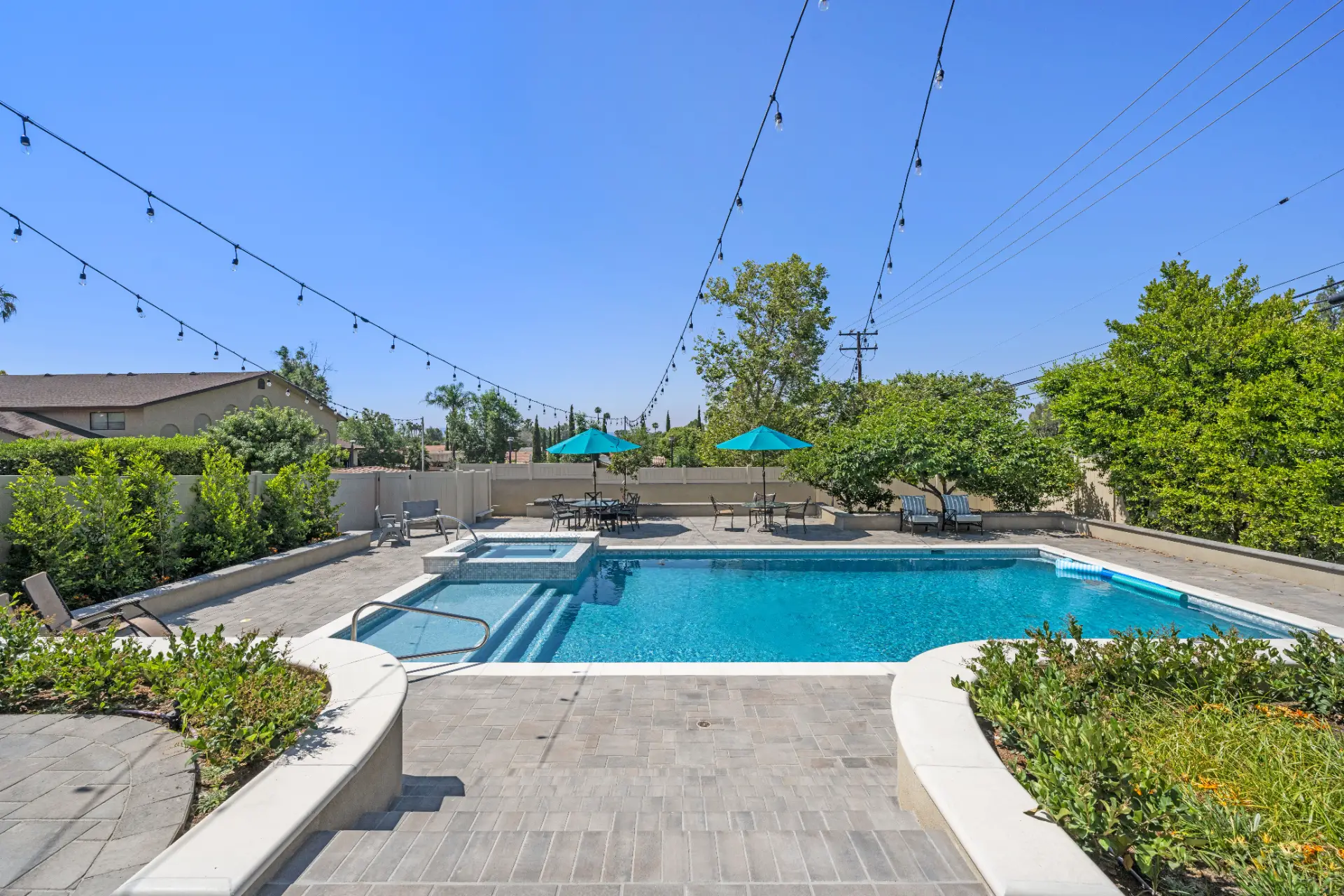
In a tired yard there’s usually more to remove than it looks. An old slab may be poured over a second slab from an earlier owner. Decks come with footings, dead lawn comes with roots and soil, and abandoned irrigation lines are buried under all of it.
Backyard demolition is mostly about access. A narrow side yard or a gate that won’t fit a skid steer means concrete gets broken up and carried out by hand, which changes the haul-off and the schedule.
Not all of it has to go to a landfill. Broken concrete can often be recycled into aggregate, and soil and green waste can go to processors. California’s green building code, CALGreen, requires at least 65% of construction and demolition waste to be diverted from landfills on new buildings and on residential additions and alterations that increase a structure’s conditioned area, volume or size, as CalRecycle’s summary of the CALGreen requirements explains. A backyard tear-out on its own usually doesn’t add conditioned space, so the state rule often doesn’t apply. Many cities have their own construction and demolition recycling ordinances, though, so we check what your city requires when the permit is pulled.
Bad drainage is behind more failed backyards than anything else. Water sitting against a slab undermines it, water running toward the house gets into the wall, and water under a deck rots the framing. Rebuild on the same grades and the new yard fails the same way, so in a yard renovation drainage is designed before the surfaces are. That usually means:
Where the water goes next matters too. You can’t fix your drainage by sending it over the wall onto a neighbor’s lot. In Orange County, storm drains carry water to creeks and the ocean without treatment, along with whatever fertilizer, pesticide or loose soil it picked up, as the county’s H2OC stormwater program explains. A good plan keeps more water on your lot and sends the rest to an outlet your city allows, usually the street gutter or a curb drain. During construction, we keep soil and concrete washout out of the gutter.
Many yard renovations involve a lawn that’s dead or too expensive to water. Two sets of rules are worth knowing first.
The state landscape ordinance. California’s Model Water Efficient Landscape Ordinance, or MWELO, sets water budgets and irrigation standards. The California Department of Water Resources maintains it, and cities and counties adopt it or something stricter. Under the County of Orange’s MWELO compliance form, a rehabilitated landscape under 2,500 square feet is exempt, and so is a project that isn’t tied to a building or grading permit. A permitted rehabilitated landscape of 2,500 square feet or more has to comply. Most backyards fall under that, but large lots with grading permits can cross it, and then we prepare the water budget and irrigation plan with the drawings.
Turf replacement rebates. The Metropolitan Water District of Southern California runs a turf replacement rebate through SoCal Water$mart, and many local water agencies add to it. Terms change, so we don’t quote amounts. The planning rules, per the program’s turf replacement FAQ:
So if you want rebate money for the lawn area, that part of the yard has to be planted and permeable, not paved. We settle that in design, before you apply.
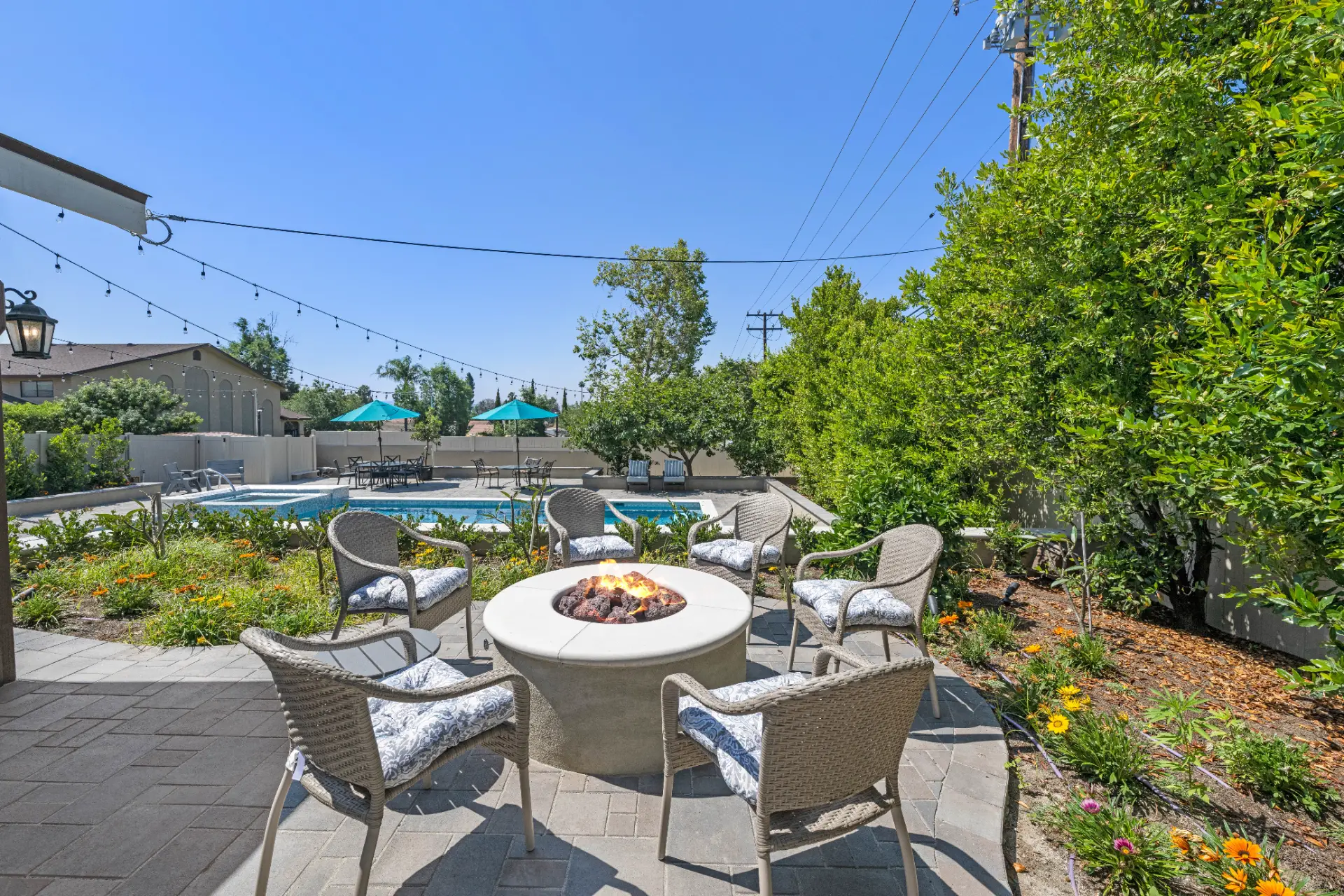
Hillside lots in both counties often come with a slope nobody has touched in years. Ivy hides erosion, railroad-tie walls rot from the back, and a block wall that was fine at three feet leans once someone stacks two more courses on it. Renovating a slope means clearing it, seeing how soil and water behave, and choosing between a wall, terracing or better planting. Many Southern California building departments require a permit when a retaining wall is more than 4 feet tall measured from the bottom of the footing to the top of the wall, or when the wall holds back extra load, called surcharge, such as a driveway, a structure, or a slope above it. Some cities add tighter rules near steep slopes. Rancho Palos Verdes, for example, also requires a permit for walls over 30 inches built within 10 feet of a slope steeper than 20%, as its retaining wall handout shows. Your city’s rule is the one that counts, and we confirm it before design.
A permitted wall gets engineered footings, inspections and drainage behind it, which is what keeps it standing; most wall failures come from water pressure with no way out. For more on walls, pavers and patios as standalone projects, see hardscape and outdoor living.
Older pools often have a sound shell and a failed surround: a cracked, lifted deck, loose coping, and an expansion joint that lets water under the slab. We can replace the deck and fix the drainage behind the damage while the pool stays. If the pool itself needs work, see pool remodeling; we schedule both together so the deck isn’t poured twice.
Southern California backyards are full of work that never saw an inspector: patio covers bolted to the eaves, decks built on whatever was handy, and gas or electrical lines a previous owner ran to a barbecue. Sometimes it’s obvious; often it isn’t until demolition starts.
Unpermitted gas and electrical work can be a safety problem, and any of it can cause trouble when you sell. When we find it, we remove it, rebuild it to code with a permit, or, where the city allows and the work is sound, permit it as built. You get the recommendation in writing, with any cost and schedule change, before work goes ahead. We’d rather find it before the contract is signed, so at the site visit we look at every structure and ask what you know about its history. Your city’s building department can usually pull the permit records for your address.
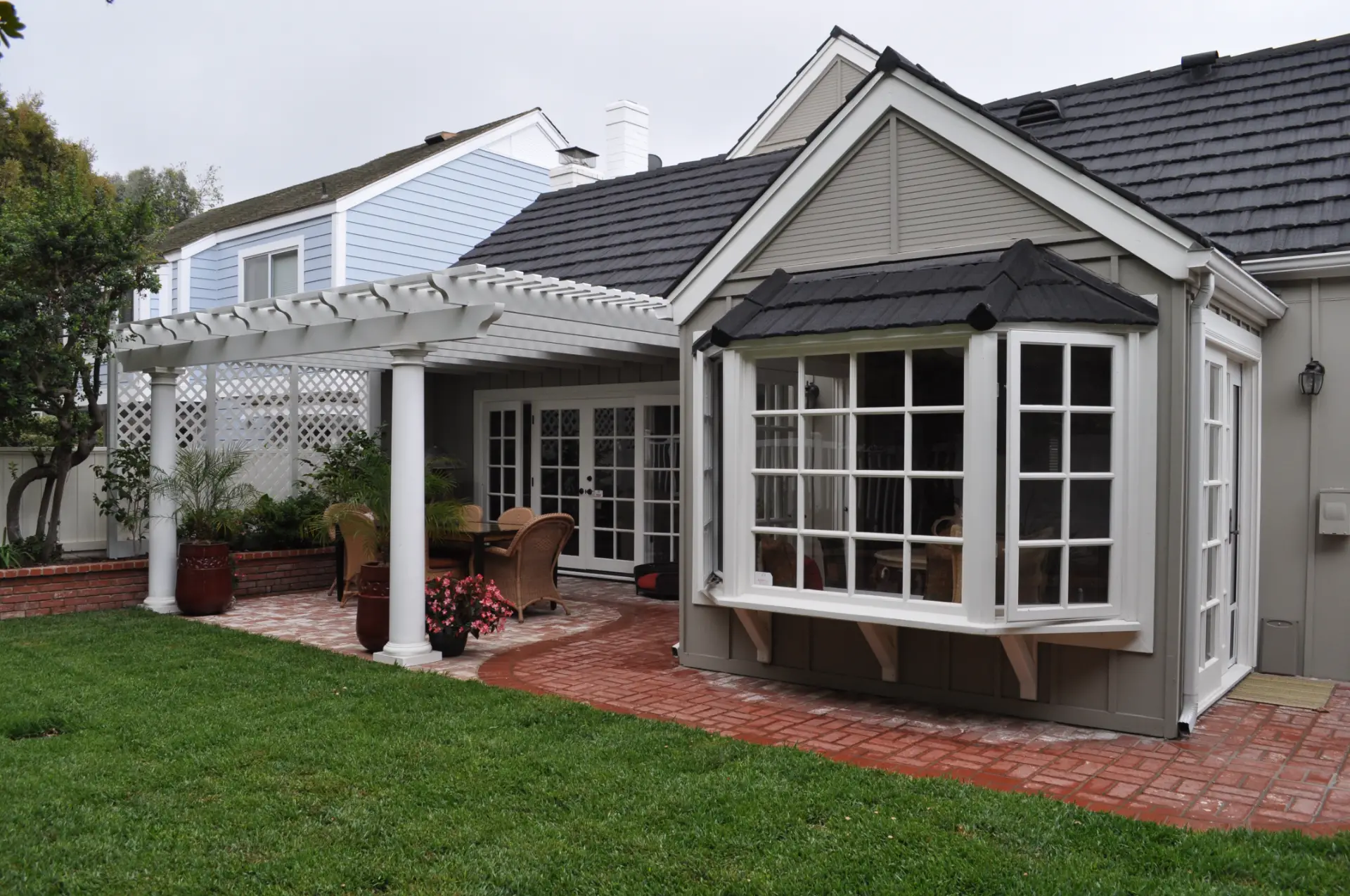
Many canyon and hillside neighborhoods in both counties sit in mapped fire hazard severity zones; the State Fire Marshal’s zone maps show whether your address is in one.
If yours is, a renovation is the time to fix the area closest to the house. CAL FIRE’s defensible space guidance calls the first five feet, Zone 0, the most important, because that’s where embers land. That means hardscape or gravel instead of bark mulch, no wood fencing attached to the house, and nothing stored under decks. The State Board of Forestry’s specific Zone 0 rules for very high fire hazard severity zones are being phased in, so we check what applies to your address when we design.
One of our recent finished projects is a backyard in Fullerton built around a glass-roof patio cover. A glass roof keeps rain off the patio without darkening the rooms behind it.
If a covered area is on your list, our outdoor kitchens and California rooms page covers patio covers, enclosed rooms and the permits they need.
We don’t publish price ranges for yard renovations, because two yards of the same size can come out very differently. These are the factors that move the budget most:
After the site visit, you’ll get a line-item proposal that separates requirements from choices.
When a yard renovation is part of a bigger plan for the house, we can coordinate it with an exterior remodel or a complete home renovation so the outside and inside are built on one schedule.
We work throughout Orange County and Los Angeles County, including Fullerton, Anaheim, Yorba Linda, Orange, Tustin, Irvine, Mission Viejo, Laguna Niguel, Huntington Beach, Whittier, Long Beach and Torrance. If you’re not sure we cover your area, contact us and ask.
We work across four Southern California counties. Each county page links to the city pages, with local permit and housing details for every city we serve.
It depends on scope, permits and access. Demolition and new hardscape move faster than a job with retaining walls, a patio cover or a rebate approval to wait on. You get a project-specific schedule with the proposal.
Not for everything. Replacing plants or resurfacing a small patio often doesn’t need one. Retaining walls over your city’s height limit, patio covers, decks above a certain height, new gas or electrical lines, and significant grading usually do. We check your city’s rules and pull every permit the project needs.
Often, yes. The Metropolitan Water District’s turf replacement program and many local water agencies offer rebates, but you must get approval before removing any grass, the new area has to stay permeable, and synthetic turf doesn’t qualify. We can design the yard so the right areas meet the rules.
We tell you what we found and recommend removing it, rebuilding it to code, or permitting it as built where the city allows. Any change to cost or schedule comes to you in writing before we proceed.
Yes. Many renovations replace a cracked deck and coping and fix the drainage while the pool stays. If the pool also needs work, we schedule both together.
A backyard renovation fixes and rebuilds a tired yard, starting from what’s failed. Our complete backyard remodeling service designs a full outdoor living space, with a pool, kitchen, cover and hardscape planned together. Many projects use some of both.
Tired of patching the same yard? We’ll walk it with you, find out what’s failing and why, and show you what it takes to rebuild it right. Schedule a consultation or call (714) 449-9035.
